Munch
Going to a Munch as a Couple
By Aster Quill, Rope-scene dating writer Published 25 August 2026
A munch is a social meetup with no rope anywhere in it. A pub back room or a quiet cafe, an organiser at the end of the table, two hours of ordinary conversation. Couples turn up to these constantly, and it is the one scene room that requires almost no preparation to walk into as a pair.
Which is why the failure here is not nerves. It is coming away with nothing, four times in a row, and concluding that the local scene is not very friendly.
What a table sees when two people arrive together
Almost instantly, and without anyone deciding to: a unit.
The signals are small and they are not the ones people think. Arriving at the same moment. Sitting adjacent. One coat going over two chairs. A joint round. A conversational habit where one of you finishes a story the other started, which married people do constantly and never hear themselves doing.
Within ten minutes the table has filed you, and the filing has two effects. The first is that nobody is going to approach either of you as a prospect, which is mostly a relief and occasionally a small deflation that people are embarrassed to notice in themselves. The second is that a pair is harder to join than a person. Somebody deciding where to sit will pick the individual over the couple nearly every time, because two people mid-conversation look complete and one person does not.
None of that is hostility. It is the ordinary physics of a table, and it operates on couples who have been together fifteen years exactly as it does on ones who met in March.
Being read as unavailable
This is worth separating out because people carry an anxiety about it that does not match what happens.
Being read as unavailable costs you very little socially. Scenes are full of couples and nobody minds. What it does affect is the texture of the conversations you get: slightly more general, slightly less confiding, and noticeably fewer of the ones where somebody tells you something real about their own situation. People calibrate what they say to who they think is listening, and two people listening is a different audience from one.
There is a specific version of this that catches out pairs where only one of you is known locally. The regular gets the usual conversation and the partner gets the introductory version, over and over, all evening. By the fourth telling of what brought you here, the partner has stopped enjoying themselves and nobody at the table has any idea.
Where the reading genuinely goes wrong is at the edges. Rooms assume monogamy from a couple and assume availability from anyone sitting alone, and both guesses are wrong often enough to cause small awkwardnesses. You do not need to announce anything. It is worth the two of you knowing what you would say if it comes up, so that the answer is the same from both of you.
Sit apart, on purpose
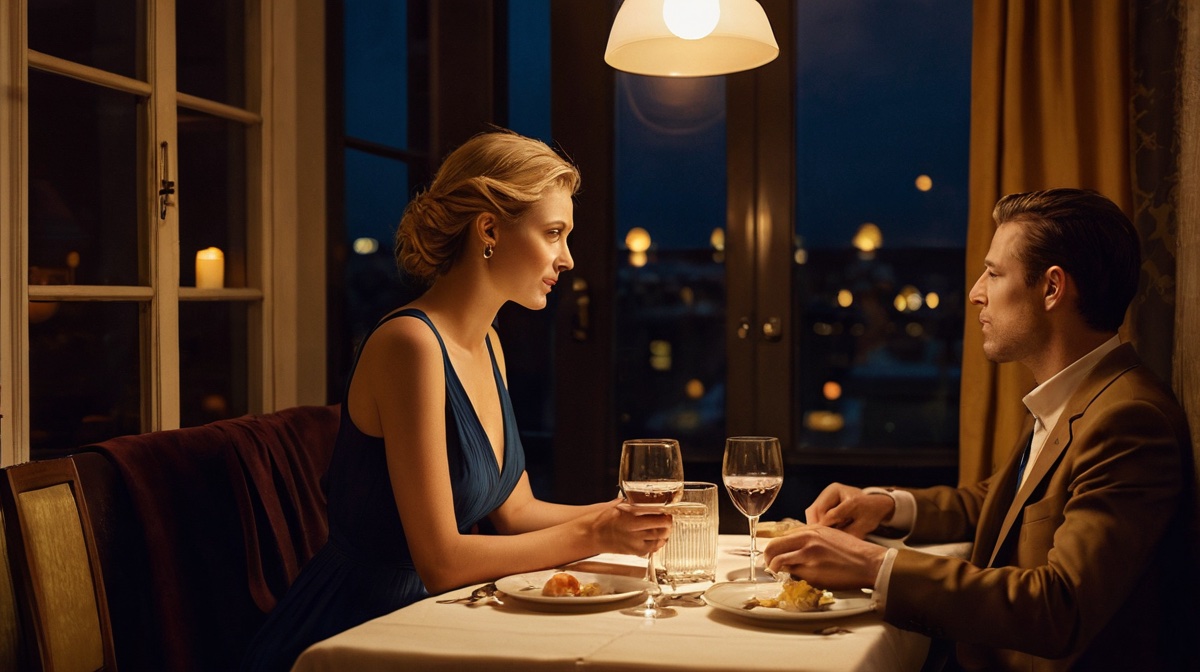
The correction is almost embarrassingly small and it has to be deliberate, because neither of you will do it by accident.
Agree beforehand that you will spend part of the evening at different ends of the table. Twenty minutes each is enough. Long tables help, since moving is easy and nobody reads it as anything. What you are undoing is not intimacy, it is the visual fact of a closed pair, and the difference in how many people speak to you is larger than it has any right to be.
There is a second reason to do it that has nothing to do with networking. You will hear different things. Every couple who does this reports the same small oddity: comparing notes afterwards, you both learned something the other did not, from people you both know. That is what the seating did.
The version that goes wrong is one of you drifting off while the other spends an hour scanning the room, which the table can see perfectly well. Splitting up reads fine when both of you know it is happening.
The questions couples get, and the ones you should not answer
There is a standard set and it is worth having thought about them once.
How did you two meet. Do you both do it, or is it one of you. Which of you is which. Whether you play with anybody else. Some of these are ordinary friendliness and one or two of them are people working out where to place you, which is also ordinary friendliness in a small community.
Answer them however you like. The thing to watch is not the content, it is the reflex. When somebody asks your partner a question and you answer it, the table registers it and your partner registers it more. This happens most often to the less-established half, gets done most often by the person who has been coming longer, and is nearly always meant kindly. It is also the single most common complaint from people who get taken along to things.
The same reflex has a sharper form, which is the joint answer to a question about only one of you. Somebody asks your partner what they enjoy about it and receives a description of what the two of you do. Small, constant, and it slowly removes one person from their own evening.
If either of you is new to the room and finding this hard to spot in yourselves, the etiquette page sets out the general version of how couples get read at events.
What the evening is actually worth to a couple
Quite a lot, and not for the obvious reason.
The obvious reason is information: which local classes are decent, which organiser answers messages, who has moved away, where the new venue is. That is real and you cannot get it any other way, because none of it is written down anywhere.
The less obvious one is that a monthly table gives a couple an evening out that is neither domestic nor a date. Two hours in company, talking to other people, going home together. Couples years into this report that the fixed monthly slot is the thing that survives the busy stretches, whereas an intention to do more at home does not. That is roughly the argument in when rope becomes routine, arriving from a different direction.
And it does something for a pair where one of you is much keener. A munch has no rope in it, so the less-invested half is not standing about being patient while something happens that they are not part of. They are at a table talking to adults. That is a considerably better introduction to your partner’s world than any amount of explaining at home, and the version of the evening where the partner does not do rope at all is covered in bringing a partner who doesn’t do rope to a munch.
One asymmetry this page assumes away: that you both want to be there at all. When one of you dreads the evening the arithmetic changes, and the answer is usually not that both of you attend anyway.
The evening you go to when things are bad

Worth naming, because it is common and nobody mentions it.
Couples go to munches during rough patches. Sometimes for a night out that neither of you has to arrange. Sometimes because the flat has become difficult and two hours with other people in it is a relief. Sometimes because one of you is quietly checking that the friendships still exist.
All of that is fine and the table does not need to know. What does not work is arriving mid-argument and continuing it quietly. The pair having a tight muttered disagreement at the end of the table is the pair everybody has clocked, and nobody will say a word to either of you about it, then or ever.
If a room is where your relationship gets discussed rather than where it gets a rest, the discussion is going to leak, and in a small scene it will be known. What that does over a longer stretch, and who ends up keeping which night, is the subject of dating someone from your local rope scene.
Turning up again
Nearly everything a munch is good for arrives through repetition rather than through any single evening.
The first one is polite and slightly flat. The second one has two people in it who remember your name. By the fourth, somebody tells you about a thing that is not advertised anywhere, and that is the point at which a couple stops being visitors. Pairs who attend twice and stop have not really attended.
The other benefit of going back is that the unit problem softens. You will be invited as a pair, remembered as a pair and asked about as a pair for a long time, and the only thing that separates the two of you into two people is a season of turning up and being individually present in the room. There is no shortcut and there is no announcement that achieves it.
Asked at the door
Will people stop talking to us because we are obviously together?
They will talk to you less than they would talk to either of you alone, and it is not deliberate. A pair reads as a closed unit and a closed unit is harder to join. Splitting up for twenty minutes each undoes most of it.
Do we need to say we are a couple?
No, and the table will have worked it out inside ten minutes anyway. The only thing worth being clear about is whether either of you is open to anything with anyone else, because rooms guess and they guess wrong in both directions.
Is a munch a good place to go when things are difficult at home?
It is one of the better ones, provided you are not going in order to have the argument in public. A fixed monthly evening in company survives the stretches when nothing is happening between the two of you, which an intention does not.
We are looking for somebody to include. Can we do that at a munch?
Wanting it is ordinary. Conducting it at a pub table on a Tuesday is the thing rooms react to, and a pair working the table together is considerably more conspicuous than one person doing it. Say it once, in passing, to somebody who asks, and then let the evening be an evening.
The room is half the answer
Events introduce you to the scene. For the searching in between, meet members who already know what a jam is and don't need it explained.
Meet people who date this way →