Workshop
What a Rope Workshop Evening Is Actually Like
By Aster Quill, Rope-scene dating writer Published 24 August 2026 Updated 24 August 2026
Hardly anybody describes the shape of a class before you attend one, so a first booking carries more nerves than it needs to. The evening is remarkably ordinary. What nobody puts in the listing is what three hours in a teaching room does to two people who arrived together.
What an evening is actually like
You arrive at a hall, a dance studio, or a room above a pub. There is a table by the door where you pay and give a first name, shoes come off, and mats take up most of the floor. People are dressed for a gentle exercise class. The room before it starts sounds like any other adult evening course: coats, small talk, somebody apologising for the traffic.
The instructor talks for a while and demonstrates. Then everybody works while they circulate and correct, which is most of the night. Somewhere in the middle there is a break with tea and, in the better run ones, biscuits. At the end the mats go back against the wall and a portion of the class walks to the pub.
Two things surprise most people. The atmosphere is far more ordinary than the word bondage suggests, nearer to a pottery class, right down to the person who brings their own equipment in a tidy bag. And nothing sexual happens: beginner classes are teaching rooms with that content deliberately left outside, which is why they are easy to walk into as a pair.
The pace is the other thing worth knowing. There is a lot of standing about while somebody demonstrates, then a long stretch where you are on your own with the material and the instructor is three groups away. Couples who expected constant supervision find that stretch longer than they anticipated. It is also where most of the learning happens, and where most of the friction between two people shows up.
Partner rotation versus bring-a-partner
Before booking anything, read one line of the listing carefully: whether the class rotates partners or expects you to bring your own.
Rotation classes pair students up and reshuffle through the session, running on a rhythm of short exercises with different people. Most beginner series use the format. Bring-a-partner classes assume a fixed pair and never reshuffle, which suits couples and established practice pairs working on their own progression.
Neither format is better. They are different tools, and most scenes run both. What matters for a couple is that they produce completely different evenings. A bring-a-partner class is three hours of the two of you, which is either exactly what you wanted or a slightly claustrophobic version of home with an audience. A rotation class separates you for most of the night and hands you back at the break.
Listings do not always make this obvious, and organisers get asked constantly, so asking is normal. “Is this rotating, or do we work as a fixed pair?” gets a one line answer and saves a mismatched evening.
Booking as a couple
Pairs are ordinary in these rooms, and there are usually several in any beginner series. Nobody will treat you as an exception, including the pairs who met a fortnight ago, though the timing question for those is its own subject and a rope class as a first date covers why it works better as a fourth meeting than a first.
What a class gives a couple that home practice can’t is other couples at the same stage. There will be a pair slightly ahead of you, a pair stuck on exactly what you are stuck on, and a pair whose muttering makes your own evenings look serene. Most of that contact happens in the break rather than during the teaching, which is a good reason not to spend the break on your phone.
Two things are worth settling before you book. Whether you mind being separated, since a rotating class will separate you. And whether you are arriving as two students or as one student and one supporter, because a partner brought along without really agreeing to it is legible from the front of the room inside ten minutes. Settle that before the booking rather than in the car afterwards. When only one of you is into rope explains why a single reluctant attempt is a poor test of anything.
One habit to leave at home: don’t coach each other during the class. There is a person in the room whose entire job is correcting people, and a partner running a parallel commentary makes the evening worse for both of you. Learning rope as a couple covers why teaching your own partner is harder than it sounds.
Being corrected in front of your partner
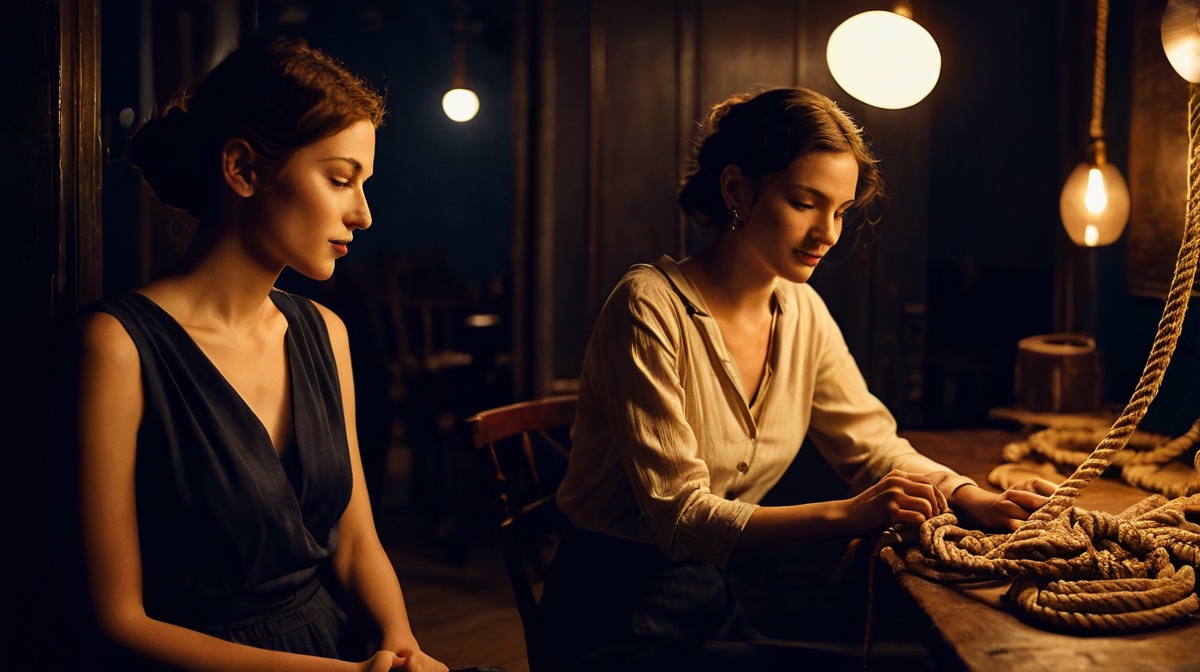
This is the part of the evening nobody mentions and most people feel. An instructor stops beside you, takes something out of your hands, and shows you what you were doing wrong, while the person you live with watches from eighteen inches away.
For the first session or two it stings slightly. After that it stops registering, because the instructor is doing the same thing to everybody every four minutes, and the whole atmosphere of a beginner class rests on the assumption that all of you are bad at this. The discomfort is about the audience of one, not the correction.
Where it goes wrong is when a partner joins in. Some of it is well meant: your partner heard the instructor say it and repeats it two minutes later to be helpful. It rarely lands as helpful. Being corrected by a teacher is neutral. Being corrected by the person who will also be in your kitchen tomorrow morning is not. If you agree one thing before the first session, agree that neither of you relays the instructor’s corrections to the other.
The reverse is worth naming too, because it embarrasses people. If your partner is the one being corrected and you catch yourself wincing on their behalf, or apologising for them to the instructor, stop. It is a heavier thing to do to somebody than it feels from the inside.
When one of you picks it up faster
It happens in most pairs and it usually announces itself somewhere around week two. One of you is getting it, the other is on the third attempt at the same thing, and the instructor has stopped by twice.
A class makes the gap visible in a way home practice does not, because there are eight other people in the room providing a scale. That visibility is uncomfortable and it is also the useful part. At home a mismatch turns into a private theory about who is trying harder. In a room you can see two other pairs with the same gap running the opposite way, and it stops being a fact about your relationship.
The thing to watch is what the faster one does with it. The common failure is not smugness but impatience wearing the costume of encouragement: small nudges, taking over to demonstrate, finishing the thing to save time. All of it reads as a verdict to the person on the receiving end, and none of it is meant that way.
The other thing to watch is the slower one quietly deciding the whole activity belongs to the other person. That decision gets made silently across two or three sessions and it is very hard to reverse later. What rope does to a relationship covers where that imbalance goes when it is left alone for a year.
When your partner is rotated to somebody else

In a rotation class this will happen within the first hour, and for some couples it is the real content of the evening.
The reality is usually undramatic. Your partner works with a stranger for twelve minutes on an exercise, both of them slightly awkward and mostly concentrating, and then the instructor calls the change and everybody moves. Nothing about it is private. The room is lit, the teacher is walking around, and somebody’s phone is going off in a bag by the wall.
What catches people off guard is not the tying but the ease of it: your partner laughing with somebody they met forty minutes ago. That is what a class is for, and it is still odd to watch the first time. Let it be an ordinary feeling, and if you want to say something about it, say it after you have both slept rather than at the tea urn.
A rotation only really matters if it turns into something continuing. A classmate who becomes a regular practice partner is a different arrangement from a twelve minute exercise, and worth talking about as one. Your partner’s other rope partners is the conversation to have before it arises rather than after.
The drive home, and whether you book the next one
The half hour after a class is the most useful and most neglected part of the evening. Both of you have just spent three hours doing something slightly exposing in front of strangers, and one of you probably had a worse time than the other.
Two failure modes cover most of it. The first is the debrief that turns into a review: what you should have done differently, what the instructor meant, who was better. The second is the polite silence where you both say it was good, one of you does not mean it, and the class quietly never gets repeated. If you ask one question in the car, make it about the evening rather than the material. Whether they enjoyed being there is what determines the next booking.
That next one deserves more than a shrug. Book a series rather than an evening at a time where you can, since most of the value comes from turning up again to the same faces. If one of you does not want to continue, take it seriously the first time instead of negotiating, and separate the two questions hiding inside it: whether they disliked rope, or whether they disliked being a beginner in public. Those need different answers.
A few weeks in, the class stops being the whole social world of it. A jam is the usual next room for a pair, and munches and socials will tell you which local classes people actually recommend. Rope scene etiquette covers how those rooms work.
What people get wrong when booking
Four mistakes account for most of the disappointment, and all four are avoidable at the point of paying.
Choosing a one-off taster over a series. A taster gives you an evening. A series gives you a habit, and for a couple the habit is the whole point. A weekend intensive is the third option and a considerably larger commitment, and what a workshop weekend does to a couple is worth reading before booking one as a first event.
Skipping the beginner course because it sounds beneath one of you. Everybody experienced in your local scene did it, a fair number did it twice on purpose, and arriving above the level makes you the student the instructor shepherds all night while your partner works alone.
Booking something an hour’s travel away on the strength of a teacher’s reputation. For a first course proximity beats reputation, because the benefit comes from going back, and a long journey on a wet Tuesday is the first thing a couple drops.
And booking on somebody else’s behalf. Surprising a partner with a rope class is a charming idea roughly one time in ten, and the other nine are a quiet evening for two. If you want the habit to hold rather than the gesture to land, when rope becomes routine is the longer version of the same point.
Asked at the door
How long is a workshop evening and what's the shape of it?
Usually two to three hours on a weekday night. Demonstration, practice, a tea break somewhere in the middle, more practice, then mats against the wall and a portion of the room walking to the pub. Beginner series run the same shape weekly for four to eight weeks.
We're a couple. Will they split us up?
Only in a rotation class, and the listing will say which format it is. Bring-a-partner classes never reshuffle. If being separated for twenty minutes would be a problem for either of you, that is worth settling before you pay rather than discovering it on the night.
Is it awkward being corrected in front of your partner?
For about the first two sessions, yes, and then it stops mattering because everybody is being corrected constantly. The awkward version is the one where your partner joins in with the correcting. That is the habit to leave at the door.
One of us is picking it up much faster. Does that ruin the class?
No, but it will show, because the room makes the gap visible in a way home practice doesn't. It is usually easier to handle in a class than at the kitchen table, since the person doing the correcting is paid to and goes home afterwards.
Should we book a class if only one of us is really keen?
Be honest about which of you is a student and which is coming along. A partner who was brought without really agreeing to it is legible from the front of the room inside ten minutes, and a single reluctant evening is a poor test of whether they would ever enjoy it.
The room is half the answer
Events introduce you to the scene. For the searching in between, meet members who already know what a jam is and don't need it explained.
Meet people who date this way →